
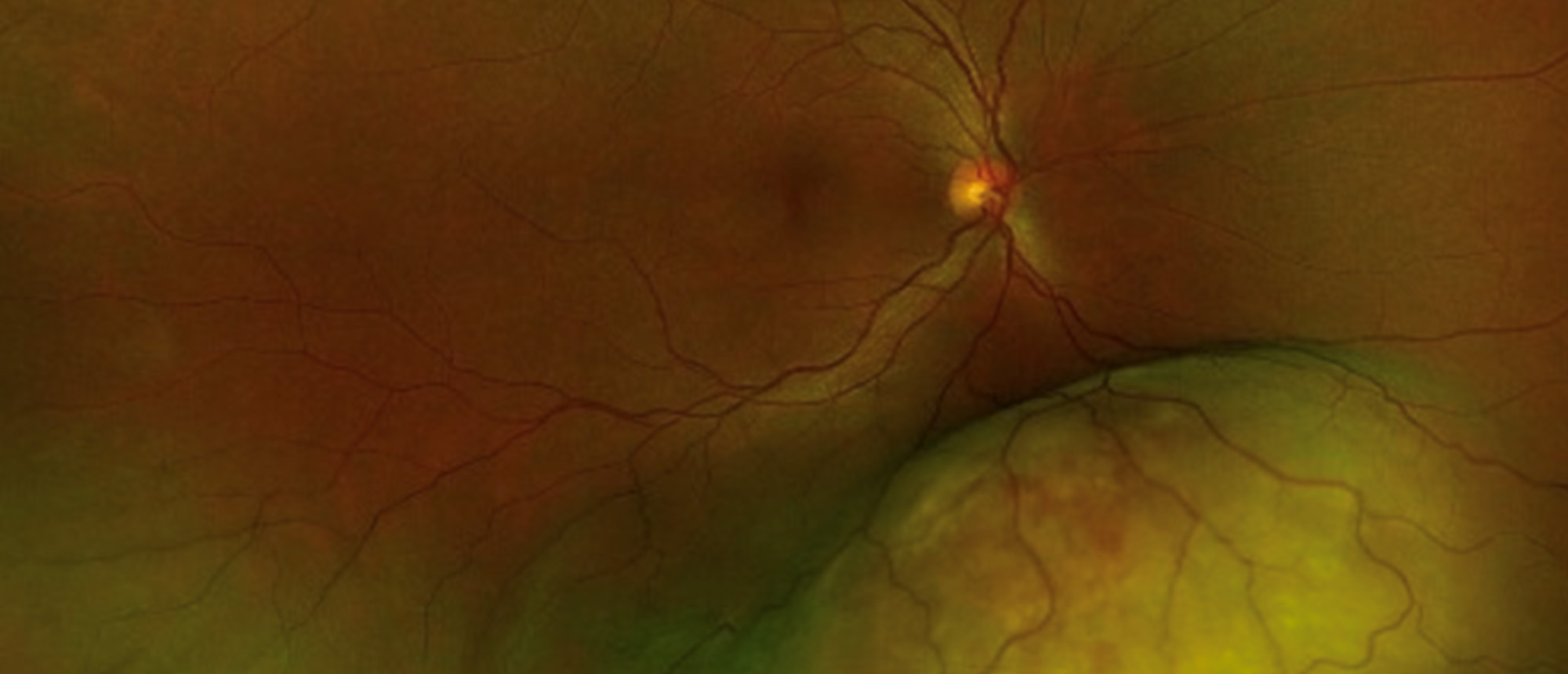
Neuroendocrine Tumor Metastasis to Choroid
Choroidal metastasis is the most common intraocular malignancy in adults, yet neuroendocrine tumor (NET) as the primary source remains a rare and diagnostically challenging etiology. We present the case of a patient who presented to the emergency department with one month of decreased vision and was referred for a suspected macula-on retinal detachment. Examination revealed an amelanotic choroidal mass with associated serous retinal detachment. Multimodal imaging demonstrated plateau-shaped configuration on B-scan ultrasonography with high internal reflectivity, and a lumpy-bumpy surface contour on OCT — features favoring metastatic over primary disease. A pertinent history of previously treated appendiceal neuroendocrine carcinoma with self-discontinued systemic therapy and subsequent hepatic metastases established the diagnosis of choroidal metastasis from a primary GI NET.
This case serves as a framework to review the multimodal imaging features that distinguish choroidal metastasis from primary choroidal melanoma, including differences in tumor color, B-scan morphology, height-to-base ratio, internal reflectivity, OCT surface contour, and fluorescein angiographic patterns. We further discuss the systematic workup of a choroidal mass of unknown primary, with emphasis on the role of chromogranin A and ⁶⁸Ga-DOTATATE PET/CT when NET is suspected — a diagnosis that standard CT and FDG-PET may fail to identify. Finally, we explore treatment paradigms for NET-associated choroidal metastasis, including local options such as plaque brachytherapy and external beam radiotherapy, as well as the emerging role of peptide receptor radionuclide therapy (PRRT) with ¹⁷⁷Lu-DOTATATE as a molecularly targeted systemic approach that exploits the same somatostatin receptor biology used for diagnosis.
Presentation Date: 03/26/2026
Issue Date: 04/03/2026
Please log in or click on ENROLL ME to access this course.
